Rano Raraku
Most of the 900 moai in the island come from the slopes of the Rano Raraku volcano. In this unique place, hundreds of sculptors and artists worked between the years 1000 and 1680 to produce giant statues of volcanic stone. Huge burins of basalt, the toki, made it possible to separate the giant sculptures from the flanks of the volcano before finishing them. Today, the visitors who walk through the external and internal slopes of the Rano Raraku can contemplate several tens of these impressive statues, most of them with their body buried. We also know there are moai that were covered by dirt, landslides, rubble and vegetal remains. In this site, a total of 397 moai were counted. Except for their hat (pukao), which came from a quarry near Hanga Roa (Puna Pau), their eyes (made of coral, obsidian or tuff) and their ornamentation, the manufacturing process of the moai was executed almost completely in the same place.
Rano Kau
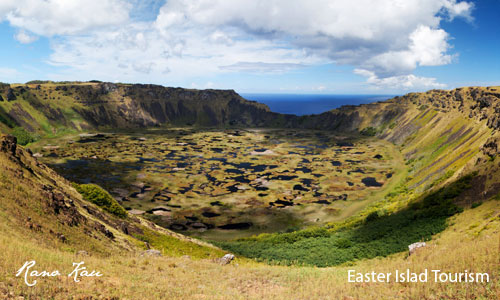
Rano Kau has a crater lake which is one of the island’s only three natural bodies of fresh water. Most of the volcano is on the coast and has been eroded back to form high sea cliffs which at one point have started to bite into the crater wall. On its northern side, the volcano slopes down to Mataveri International Airport.
Rano Kau is in the world heritage site of Rapa Nui National Park and gives its name to one of the seven sections of the park. The principal archaeological site on Rano Kau is the ruined ceremonial village of Orongo which is located at the point where the sea cliff and inner crater wall converge. One ahu with several moai was recorded on the cliffs at Rano Kau in the 1880s, but had fallen to the beach by the time of theRoutledge expedition in 1914. As well as basalt, it contains several other igneous rocks including obsidian (for which it was one of the major sources for the island’s stoneworkers) and pumice. The crater is almost a mile across and has its own micro climate. Sheltered from the winds that dry most of the rest of the island, figs and vines flourish at Rano Kau
Terevaka
The Mauga Terevaka is the highest point of the island, and also the most recent. It emerged during the last volcanic phases of Rapa Nui, about 250,000 years ago. This summit is 511 m high and is surrounded by other two tops, the Maunga Puka and the Maunga Kuma. Further down there is a crater lake, the Rano Aroi, which is the third fresh water reserve in the island (along with the Rano Raraku and the Rano Kao.) This place does not present much archeological interest, but the visitor can see the whole island from this viewpoint. It is an ideal space for footing and jogging lovers, and also for people looking for some peace and quiet. During the hot summer, it is a cool spot. In the summit of the Terevaka the wind always blows.
The Poike
Located to the east of Rapa Nui, it is crowned by the Maunga Pua ka Tiki and the small domes of the Maunga Parehe: Maunga Tea Tea and Maunga Vai a Heva. This eroded mountain 370 m high is the oldest from a geological point of view, and presents a volcanic structure which is different from the rest of the island. The whitish lava of this peninsula is a type of white trachyte that the current artisans use to carve the moai. The lack of stones in the ground of this area dedicated to stockbreeding is not a result of the superhuman labor of a legion of slaves, but of the own nature of the land. On the southern side, the Maunga Vai a Heva presents an original sculpture oriented to the summit, a sort of giant gargoyle whose mouth was possibly used to collect rainwater. Beyond the three small hills to the north of the Poike, the visitor can admire some petroglyphs shaped as hooks, and above all, five moai made of white trachyte at the Kava Kava ahu. Finally, the visitor can access many caverns on the cliff with a local guide and certain difficulty. One of them served as a cemetery, and the most famous, Ana O Keke, was used to initiate noble young virgins.