miércoles, 2 de mayo de 2012

Hanga Roa church. Easter Island.


Hanga Roa

Worth visiting during Sunday Mass, the Church of Hanga Roa, located in the streets Te Pito o Te Tu’u Henua and Koihu. Inside are intricate wooden sculptures that illustrate the adaptation of the Rapa Nui to Catholicism.

Caleta Hanga Roa

The moai are found across the island, but the two overlooking Caleta Hanga Roa, the Ahu Tautira probably will be your first encounter with them. The small bay is used by local fishermen, and in the mornings you can buy fresh fish.
Nearby you will find Pea Beach, near the port, which has a rock pool ideal for swimming. Beside, the area is the best for surfing, diving and snorkeling.

The Tahai Complex

The ceremonial complex of Tahai, famous for its sunsets, is located beyond the small cemetery of Hanga Roa. On a small accessible slope covered by grass, the visitors will discover many restored ahu, as well as numerous remains of houses, the well-known boathouses where the family of the notable islanders lived. The only things left of these buildings are the stone foundations and the pavement of the ground with the holes to receive the wooden skeleton.

When talking about Tahai, it is necessary to make a distinction between the Vai Uri ahu and its five statues, the Tahai ahu with its unique statue, and the Ko Te Riku ahu. To the north, over the Hanga Ki’oe ahu is located the Moai A Kapu. Not far from there, slightly dominating Tahai, was built the Easter Island museum, initially financed by Japan. The Father Sebastian Englert Anthropological Museum exposes a very small part of the island’s lithic utensils, a collection of old fishing hooks, the first coral eye discovered in Anakena, and many other valuable pieces such as the splendid Kava Kava moai. In the warehouse remain other 20,000 pieces, which were inventoried thanks to a private foundation’s financing. However, due to the lack of bigger resources, it is difficult for the museum to expose more objects in their showcases because, like in other places, great vigilance and expensive security measures are needed in order to prevent the theft of antiques, which makes it difficult to expand the exhibition rooms.

miércoles, 11 de abril de 2012

Map of Easter Island


martes, 6 de marzo de 2012

Martirius Deep Sea Fishing


Mauritius is a paradise for deep sea fishing. Species include the blue or black marlin, all types of sharks, yellow tuna, the Bonitos, the ‘emperor’, the ‘pélerin’, the ‘bécune’ or the barracuda.
Huge fishes like the Blue Marlin roam our seas and hunt around the island from November to April, and very often until May. The ocean is 70 metres deep one kilometre away from the coast. Mauritius holds several world fishing records (IGFA), including that of the mako shark of 1115 pounds, the blue shark of 400 pounds, a bonito of 41.5 pounds, a white tuna of 224 pounds and a ‘bécune’ of 125 pounds. African records (GFUA) mention a yellow tuna of 212 pounds and a white tuna of 224 pounds. Other specimens recently caught include blue marlins of 1430 and 1355 pounds. Fishing boats can be hired from almost all hotels. The most prestigious deep sea fishing competition is the Marlin World Cup which is hosted in December by La Pirogue Hotel.

martes, 14 de febrero de 2012

Mauritius is a blend of diverse cultures and religions which our immigrant population brought from their ancestral countries. Their festivities are celebrated in a spirit of peace and harmony throughout the year.

Cavadi
This festival is celebrated in January/February. Bodies are pierced with needles, tongues and cheeks with pins, devotees in a trance carry the ‘Cavadi’ on their shoulders as a penitence. The ‘Cavadi’ is a wooden arch, covered with flowers and with a pot of milk at each end.


Divali
The Festival of Lights is celebrated in a spirit of pure joy, in the month of October or November. Small clay lamps line the walls, balconies and yards. They are lit at sunset. Their golden light, which is believed to guide the Goddess of wealth and good fortune, can be seen everywhere. Divali represents the victory of truth (light) over ignorance (darkness). The Festival of Lights, Divali, is a celebration of joy, happiness and for many Mauritians, a time for sharing.

Father Laval
Every September 9, Mauritians of all faiths walk or drive towards the tomb of the Blessed Jacques Désiré Laval, the «Apostle of the Black People» at Ste-Croix, Port-Louis. The belief in Père Laval, to whom powers of healing are attributed, reminds us of the Lourdes Pilgrimage in France.

Ganesh Chaturthi
Ganesh Chaturthi is celebrated on the 4th day of the lunar month of August/September by Hindus in honour of the birth of Ganesha, God of wisdom.

Holi
This Hindu festival is as colourful as the many legends from which it
originates. It is above all a festival of joy during which men and women throw coloured water and powder on each other and wish one another good luck.


Id-El-Fitr
The Id-El-Fitr festival signals the end of the Ramadan - the fasting
period for Muslim people. Prayers are said in mosques all day long.

Ougadi
Ougadi is the Telugu New Year and is usually celebrated in March.

Spring Festival

The Chinese New Year is celebrated each year on a different date, owing to the differences between the lunar and the solar calendars. Houses are thoroughly cleaned before the festival. No knife or scissors are used on the actual day of the festival. Red, a symbol of happiness is the main colour of the day. Food offerings are made to ensure that the following year will be plentiful and traditional ‘Wax’ cakes are distributed to parents and
friends.Firecrackers are set off to drive away the evil spirits.

Whether in your hotel or on the beach, the sega, a dance invented by mauritians of african origin, has become synonymous with «joie de vivre». The sega, its music and dance form, is specific to Mauritius. The sega, mainly based on African music originating with slaves, is nowadays played with modern instruments and features contemporary musical influences.

The rubbing of feet, the swaying of hips and Creole lyrics are part and parcel of the music. The slaves obviously began dancing the sega to forget their miserable existence. There are now several types of sega in Mauritius. Standard sega (where the instruments are the ravanne, the maravanne and the triangle) has its own disciples and devotees.


This «type of sega» had its own poet: Ti Frère, who died at the age of 92 and left us with a fantastic legacy.
«Ti Frère’s segas, said Mauritian writer Jean-Marie Leclézio, are never dull, he cannot be bothered producing holiday songs. They are tough and authentic, sensual and pagan. He knows how to tell us about Anita’s and Angeline’s love lives, and scoff at politicians who eat for the people’s sake».,
Young people and hotel entertainers now favour a more modern version of sega, which is no less attractive.

viernes, 10 de febrero de 2012

City of Zagreb. Croatia.

Zagreb is the capital of the Republic of Croatia, its almost a million strong political and diplomatic, cultural, economic, mercantile, transport & communication and sports centre. It is a town of contrasts – young and old at the same time, dedicated to business in the morning, relaxed and fun loving in the evening, a typical European metropolis in many ways but at the same time it is city its guests remember for the charm of its centre and hospitality of its citizens.
Zagreb, Croatia’s capital and the largest city in the country, is a typical Central European town. It grew out of two medieval settlements that flourished for centuries on neighbouring hills. Zagreb’s written history dates to the year 1094, when a diocese was established there. The classicist and secessionist facades of its historical nucleus exude the lofty spirit of the Austro-Hungarian Empire, but here and there one can also discern the contours of the panoramas of Prague. Almost all of the main sites of the city and cultural venues are located in the very centre, which teems with charming coffee houses, fine restaurants, garden restaurants, and lovingly tended parks like, for instance, Ribnjak, which lies beneath the walls of Kaptol. The pivotal point of the city is the magnificent Gothic cathedral with its filigree spires. Zrinjevac, a park located only a few steps away from the main square, also forms part of the Lenuci green horseshoe that encompasses some of the most beautiful buildings in town. Zagreb, indeed, is a city tailored to the human scale.

martes, 7 de febrero de 2012

Martirius Honeymoon


If you are looking for a very special place to spend your honeymoon, Mauritius is definitely the place for you. Every hotel on the island offers extensive wedding and honeymoon packages. They can also help you in organising every single detail of the ceremony.
Everything is possible. You can choose to have an intimate, private occasion or a more adventurous way of exchanging vows.
On a sunny beachside, under the sea or in the sky, Mauritius will transform your wedding or your honeymoon into an unforgettable moment.


GETTING MARRIED IN MAURITIUS
> The «Marital Status Act» specifies that non-residents can get married the day following the posting of the marriage banns.

> However, the couple must obtain a certificate that the Prime Minister’s Office issues to the Registrar of Births, Deaths and Marriages stating that they are not


Mauritian citizens or Mauritian residents.
This certificate can be obtained beforehand by sending a request to the
Registrar of Births, Deaths and Marriages, 7th Floor, Emmanuel Anquetil Building, Port-Louis. Tel: (230) 201 1727, Fax: (230) 211 2420. The document must be accompanied by 2 birth certificate copies of both spouses and of their passports (first three pages), as well as any other document relating to cases of divorce or widowhood.

> A request for a non-resident certificate must reach the Registrar of Births, Deaths and Marriages at least 10 days before the date set for the marriage. A Marriage can take place in the presence of a Registrar of Births, Deaths and Marriages or at the hotel.

>Catholics wishing to get married in Mauritius are requested to contact the Port-Louis Diocese to obtain the necessary information. Tel: (230) 208 3068
Fax: (230) 208 6607

viernes, 3 de febrero de 2012

Slavonia. Croatia

Come the harvest time this song reverberates through the air, precious folks costumes are taken out of old wooden chests and age-old customs brought to life – all in order to preserve the Slavonia as it used to be for the future of Slavonia. Take a walk through the Old Town of Osijek, visit the traditional villages of Baranja and the Kopački rit Nature Park, go mountaineering, enjoy the many rich thermal spring. And wherever you find yourself, you are going to be met with a warm welcome and friendship so typical of Slavonia and its people.


Shaped by the force of the mighty rivers Drava, Danube, Sava and Ilova, Slavonia is a mythical region that for centuries has guarded its treasures. It is characterised by the wide, endless expanse of the golden Pannonia plains, and by rivers that gave birth to the flood areas, which, in turn, provide an ideal habitat for the now centuries-old forestsof common oak (Quercus robur) as well as for more than 2000 biological species. The soil of Slavonia has been tilled by human hand for over 8000 years. Ever since this part of the continent rose from the Pannonian Sea some 370 million years ago - the geological history of which is best told through the eruptive rocks of the bulky Papuk mountain that sits like a crown upon this noble land - the fertile Slavonian plains have been a promised land.

viernes, 27 de enero de 2012

Central Croatia

Central Croatia is the area lying in the valleys of the rivers Sava, Drava and Mura. Visiting it means getting to know the continental character of the country, see the lowlands that are so ideally complemented with mellow hills and mounts the slopes of which are mostly covered with vineyards, walk the forests of oak, beech and other deciduous trees, visit medieval burgs, castles and manor houses.
Have you always longed for a holiday away from the summer heat and the vibrant atmosphere of the Mediterranean in an idyllic, green and hilly environment with ancient woodlands, vineyards and rivers? Do you favour the tranquil and soothing atmosphere of the mainland, where romantic medieval towns, summer homes and manors dot the countryside? where thermal springs, health spas and places of pilgrimage beckon? In that case, you should set out to the north of Zagreb and enjoy the blessings offered by Central Croatia.

viernes, 20 de enero de 2012

Kvarner. Croatia.

Here the littoral landscape is practically in the immediate vicinity of the mountainous and forested region of Gorski kotar, the Mediterranean clime and way of life are first neighbours with the harsh mountain climate, while the world of a fashionable tourist resort boasting a150 year long tradition is so vastly different from the simple rhythm of the island life. Kvarner is a place where those seeking the glitter of trendy summer resort - like the lovely Opatija whose tourist tradition, parks replete with lush greenery and elegant villas, combined with the 12 km long promenade by the sea, attract guests throughout the year.


Perhaps you imagine an ideal holiday, one where you can set off from the shore towards sunny islands, and then sail back to seek the peace and quiet of a mountain peak. In the process you dream of a sun-bathed Riviera that can, should you so wish, be replaced within a span of 10 km by ascetic peace and fresh mountain air where you are in the company of eagles, wolves and bears, and where your lungs are filled with forest scented air. If that is indeed the case, then you are looking for Kvarner and Gorski kotar - separate parts of this small country that differ significantly one from the other.

viernes, 13 de enero de 2012

Dalmatia - Split. Croatia.

Olives, indigenous aromatic plants, brilliancy of white stone against the verdant vegetation and the towering mountain massif of Biokovo whose spurs reach all the way to the sea – yes, this is indeed an exceptional part of the country, and its beauty is made all the more enchanting by numerous historic events and monuments, and cultural manifestations. In short, this is an ever interesting region full of attractions which draws a great many visitors.
When, in the year 305, the Roman Emperor Diocletian, who ruled the entire world at that time, decided to build his leisure time abode - in which he intended to spend the rest of his life - he had no doubt as to exactly where build to it. In the very heart of Dalmatia, in the bay of Aspalathos (Split), well protected from the sea by the islands of the Split archipelago, and defended on its landward side by high mountains, Diocletian created a special point on the map of the Adriatic: the future city of Split.

viernes, 6 de enero de 2012

Dalmatia - Šibenik. Croatia.


Set amid the wild beauty of white karstic rock and the azure sea, the Šibenik aquatorium is a yachting paradise, boasting as many as 240 isles and reefs, each of which holds an interesting feature or two. If you want to meet the best known coral hunters in the Adriatic, set sail for Zlarin. If you wish to see the centre of sea sponge harvesting, then Krapanj is your destination. On the other hand, if you seek an experience like no other, then venture into the open sea and discover the Kornati Archipelago.


Two national parks with only 50km between them could not be more different. The Kornati National Park is an archipelago of 89 islands, isles and reefs (numbering in total 152 units) of incomparable beauty which offers the boaters the pleasure of sailing, the formidable sheer cliffs filling them with delight and awe in the same breath. Enchanted with their striking beauty, the famous writer George Bernard Shaw wrote one of the best descriptions of the Kornati: “On the last Day of Creation God wished to crown his work and he created Kornati out of tears, stars and breath”. In contrast, the Krka National Park is full of travertine barriers, waterfalls and lakes the wondrousness of which take one’s breath away. Indeed, they are regarded as one of the favourite tourist picture postcards from Croatia.

jueves, 5 de enero de 2012

Caves of Easter Island


The Te Pahu network

Located below the Akivi ahu in an area called Roiho. It is a long tunnel of lava, the biggest one in the island, where people could take shelter from the raids conducted by slave drivers. It is easy to access the tunnel through the collapsed ceiling, and only a flashlight and a pair boots are needed to explore it, since very few parts are flooded. Thanks to several natural skylights, it is easy to find one’s way in the caverns. This lava tube formed by the hardening of a basalt layer during the flow of a lava river is one of the many caverns in the island. It probably solidified less than 10,000 years ago, during the eruption of the Munga Hiva Hiva volcano, the last volcanic manifestation in Rapa Nui. These natural landslides were used as gardens protected from the wind (manavai).

Ana Kai Tangata

A little further from the airport track, on the southern exit of Hanga Roa, we find the cavern of the cannibals (ana = cavern; kai = food, tangata = men.) However, we mustn’t reach any conclusions from a simple translation, since the cavern can be both a place where men ate and a place where men were eaten. This place is worth visiting due to some paintings of birdmen on the ceiling (unfortunately very deteriorated). From a small cornice on the left side of the cavern, the visitor can also admire the power of the waves crashing against the rocks.
Te Peu

Further up to the north of Tahai, between the long cliffs and the slopes of the Tereveka, there is an area not much visited by tourists. Here, the visitor enters the most secret area of the island. After observing the petroglyphs that represent hens and roosters near the old leper colony (the Pu Hakanini Mako’i stone), the first unavoidable attraction is the cavern of the two windows (Ana Kio) in front of the Motu Tautara. A lava tube emerges from the land near the cliff. Sliding through a narrow entrance, one penetrates this double strategic cavity that offers two exits in the middle of the cliff, one towards the sea, and the other towards the Motu Tautara. Shortly before Punta Islote there is another cavern filled with legends, a perfect lava tube with a smooth and decorated floor, as well as lava stalactites in the ceiling. In the center of this cavern named Ana te Pora it appears to be a tomb. Only steps away from this place we find the Ahu te Peu, a notable place located in front of the remains of an old town with a magnificent shiphouse more than 45 m long.

miércoles, 4 de enero de 2012

Map of Pakistan


martes, 3 de enero de 2012


Lagoons of a typically tropical sweetness and endless white beaches : Mauritius is a real paradise for those who want to enjoy the sea or just to soak up the sun. Here is a list of the island’s finest public beaches.

Grand Bay
One of the best areas for sailing, windsurfing and water skiing. La Cuvette beach has been recently upgraded.

Pereybere
This remarkable small cove half-way between Grand Bay and Cap Malheureux is one of the finest bathing spots on the island.

Belle Mare
Miles and miles of white and spotless beaches from Belle Mare to Trou-d’Eau Douce

Blue Bay
Blue Bay beach is one of the most popular bathing spots in the South-East of the island. An ideal spot for windsurfing and sailing.

Le Morne & Tamarin
Offer kilometres of beaches for bathing and are very popular for surfing.

Flic en Flac
White beaches fringed with filaos or Casuarina trees.

viernes, 30 de diciembre de 2011

Istria. Croatia

Blue seas, white stone and the green interior make up the colour scheme of Istria, the largest peninsula in Croatia. The blueness of its shoreline is contrasted by the lush greenery of its interior and the tiny, “acropolian” towns which, themselves somewhere between waking and sleeping, erase that thin line that divides the real from the illusion. And turn into your very own story.
The heart-shaped peninsula reaching deep into the clear blue waters of the Adriatic Sea is a hidden garden of beauty which opens the door to the sunny and warm Mediterranean. Come and travel through it without hesitation, and the holiday of your dreams will become reality. Multicultural and hospitable, this is an area where wide-ranging diversities have come together to form a happy union. Istria’s crystal clear sea, clean shores and ports, its lively fishing boats and teeming narrow stone streets exude the true charm of the Mediterranean. Small, picturesque medieval towns perched on the peaks of its hills emanate the peace and gentleness of landscapes that irresistibly evoke the most beautiful parts of Tuscany or Provence.

jueves, 29 de diciembre de 2011

Volcanoes of Easter Island


Rano Raraku

Most of the 900 moai in the island come from the slopes of the Rano Raraku volcano. In this unique place, hundreds of sculptors and artists worked between the years 1000 and 1680 to produce giant statues of volcanic stone. Huge burins of basalt, the toki, made it possible to separate the giant sculptures from the flanks of the volcano before finishing them. Today, the visitors who walk through the external and internal slopes of the Rano Raraku can contemplate several tens of these impressive statues, most of them with their body buried. We also know there are moai that were covered by dirt, landslides, rubble and vegetal remains. In this site, a total of 397 moai were counted. Except for their hat (pukao), which came from a quarry near Hanga Roa (Puna Pau), their eyes (made of coral, obsidian or tuff) and their ornamentation, the manufacturing process of the moai was executed almost completely in the same place.


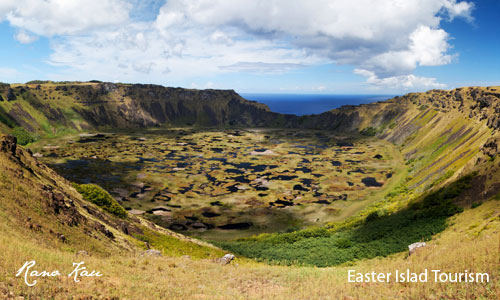
Rano Kau

Rano Kau has a crater lake which is one of the island’s only three natural bodies of fresh water. Most of the volcano is on the coast and has been eroded back to form high sea cliffs which at one point have started to bite into the crater wall. On its northern side, the volcano slopes down to Mataveri International Airport.

Rano Kau is in the world heritage site of Rapa Nui National Park and gives its name to one of the seven sections of the park. The principal archaeological site on Rano Kau is the ruined ceremonial village of Orongo which is located at the point where the sea cliff and inner crater wall converge. One ahu with several moai was recorded on the cliffs at Rano Kau in the 1880s, but had fallen to the beach by the time of theRoutledge expedition in 1914. As well as basalt, it contains several other igneous rocks including obsidian (for which it was one of the major sources for the island’s stoneworkers) and pumice. The crater is almost a mile across and has its own micro climate. Sheltered from the winds that dry most of the rest of the island, figs and vines flourish at Rano Kau


Terevaka

The Mauga Terevaka is the highest point of the island, and also the most recent. It emerged during the last volcanic phases of Rapa Nui, about 250,000 years ago. This summit is 511 m high and is surrounded by other two tops, the Maunga Puka and the Maunga Kuma. Further down there is a crater lake, the Rano Aroi, which is the third fresh water reserve in the island (along with the Rano Raraku and the Rano Kao.) This place does not present much archeological interest, but the visitor can see the whole island from this viewpoint. It is an ideal space for footing and jogging lovers, and also for people looking for some peace and quiet. During the hot summer, it is a cool spot. In the summit of the Terevaka the wind always blows.


The Poike

Located to the east of Rapa Nui, it is crowned by the Maunga Pua ka Tiki and the small domes of the Maunga Parehe: Maunga Tea Tea and Maunga Vai a Heva. This eroded mountain 370 m high is the oldest from a geological point of view, and presents a volcanic structure which is different from the rest of the island. The whitish lava of this peninsula is a type of white trachyte that the current artisans use to carve the moai. The lack of stones in the ground of this area dedicated to stockbreeding is not a result of the superhuman labor of a legion of slaves, but of the own nature of the land. On the southern side, the Maunga Vai a Heva presents an original sculpture oriented to the summit, a sort of giant gargoyle whose mouth was possibly used to collect rainwater. Beyond the three small hills to the north of the Poike, the visitor can admire some petroglyphs shaped as hooks, and above all, five moai made of white trachyte at the Kava Kava ahu. Finally, the visitor can access many caverns on the cliff with a local guide and certain difficulty. One of them served as a cemetery, and the most famous, Ana O Keke, was used to initiate noble young virgins.

miércoles, 28 de diciembre de 2011

Abbottabad. Pakistan.


It is a charming town spread out over several low, refreshingly cool and green hills. Abbottabad is 116 km (2 hours) from Rawalpindi and 208 km (3 hours) from Peshawar. Places worth visiting in Abbottabad are: Simla Hill, Ilyasi Masjid etc.

Abbottabad, is 1,222 m. above sea level, is a neat and clean town in a spacious valley surrounded by green hills. It is a popular summer resort. It serves as a base for trips to Kaghan valley and the Gallies. PTDC maintains a Tourist Information Centre here to facilitate the visitors. Places worth visiting in and around Abbottabad are; Ilyasi Mosque with a water spring, Shimla hill view point. Thandiani is another attractive hill resort 30 km east of Abbottabad at an altitude of 8,800 feet.

martes, 27 de diciembre de 2011

Maririus Inland


L’Aventure du Sucre

Visit an interactive and ultra modern exhibition situated at the heart of an ancient sugarmill and discover the fascinating history of Mauritius and its sugarcane adventure exposed over 5000 sq meters! Then, let yourself be tempted by our tropical boutik with its unique gifts, souvenirs and tasting of special unrefined sugars as well as local rum. Do not miss the opportunity to relish authentic Mauritian cuisine with refined flavours at our restaurant "Le Fangourin".
Open 7 days a week from 09h00 to 18h00 - Free access to the restaurant and the Village Boutik


Ganga Talao - Grand Bassin
Beyond La Marie and Mare-aux-Vacoas is found one of the two natural lakes of Mauritius. It rests within the crater of an extinct volcano. Ganga Talao is an important pilgrimage site and many Mauritians of the Hindu faith walk there during the Maha Shivaratri festival or the night fasting dedicated to Shiva.

Black River Gorges

This national park of 6,574 hectares was created in 1994 for the protection of Mauritius’ remaining native forests. Visitors can enjoy magnificent landscapes, with endemic plants and rare bird species. A trail leads from the Pétrin information centre to an area of typical plant life and to a conservation area. orchids.
Eureka
An old Creole residence built in 1830, Eureka is an essential place to visit during your stay in Mauritius if you wish to immerse yourself in tropical sweetness.

viernes, 23 de diciembre de 2011

Dalmatia - Zadar. Croatia


The Zadar region is the northernmost part of Dalmatia, its gate of welcome to all those who travel from the north of the Adriatic. It is full of contrasts, rich in historic heritage and breathtakingly beautiful nature. The first, and therefore perhaps the most intense experience of these parts, are the intense colours, that particular harmony of the vivid blue of the sea and over it the dark green of pine trees or olive groves that descend all the way to the shore. And to all that the brilliant white of the Dalmatian stone must be added – it forms the beaches either in slabs or broken down into gravel or pebbles, attracting numerous tourists…


Dalmatia’s centre is 3000-year-old Zadar, a city with the largest researched Romanforum on the Croatian side of the Adriatic and unforgettable Romanesquechurches like St. Donatus, St. Anastasia and St. Chrisogonus. Nearby Nin (the oldest Croatian royal city) boasts the smallest cathedral in the world (the Church of the Holy Cross measures but 36 paces!). The region of Zadar tells the story of the sources of Croatian cultural heritage better than any book.

jueves, 22 de diciembre de 2011

Easter Island archaeology sites


Vinapu

Of all the ahu in Rapa Nui, the site of Vinapu in the extension of the Mataveri airport track is undoubtedly the onethat raised more theories about the origins of the island’s population. The Vinapu is composed of two ahu, which face away from a cliff in the southeast slope of the Rano Kau, and of the remains of a third ahu located in front of the hydrocarbon storage tanks. In this place there is a deteriorated monolith and a perfectly assembled stone structure: an exciting discovery for many archeologists.

With a little imagination, the complex can be compared to a ceremonial center built by natives of the Bolivian city of Tiwanacu in South America (since the arrangement of the monoliths and the stones is similar to the walls built by the Inca people.) It is easy to forget that the Vinapu is previous to the golden age of the Incas (the ahu date from the year 1200.) Due to the absence of formal excavations, this place has remained sufficiently mysterious, so that the most liberal researchers can give free rein to their fantasies.

If we also consider the fact that the people of Rapa Nui cultivated the sweet potato (kumara), native from South America, we can understand why Vinapu became “proof” that the islanders came from Peruvian coasts. Some even outlined the theory of blonde giants similar to the Vikings who escaped from Tiwanacu and Peru in great rafts made of cane and sailed to Rapa Nui. They are supposed to be the fathers of this megalithic society, before the Polynesians arrived and destroyed their brilliant civilization. Regardless of this site’s origin, you should visit Vinapu for what it is: a place where the genius of the islanders to work the stones is fully expressed. However, in many other places of the island (not always as visible due to the accumulation of soil and sediments) we can also find this type of “Inca style” architecture. Anyway, it is possible that the Vinapu has nothing to do with South America. As for the sweet potato, researchers believe it came to the island with the Polynesians, who really sailed to South America before returning to their island.

Vaihu

In the southern coast of Easter Island, following the paved road, there is a spectacular ahu called Hanga Te’e located in a place called Vaihu. Eight statues lying down and facing the sky are lined up near the location of the old town, from which only small traces remain. On top of this ahu, which is perfectly visible from the road, there is a small and lonely statue built in October 2002. Originally, this statue was covered by dirt and weed. An old man remembered her existence, and in order to prevent it from being forgotten after his death, he revealed the secret of its location to young people, who rescued her from a tomb of dirt and oblivion.

Vai Mata

A small ahu by the precipice of Punta Atu o Puna indicates the location of the Maitaka Te Moa, an ahu built with great rocks. The walls enclose a moai from the first period, which was reused as a built-in part of the wall. Near this place, we find the Vai Mata plain, which is rich in archeological remains. One of these remains is a very easy to visit cavern, built belatedly with blocks of stones that came from shiphouses. Not far from there, we find the foundations of an interesting shiphouse, with a floor made of round stones extracted from the neighboring ahu. According to tradition, women gave birth in this place, and their babies took their first bath in a receptacle carved in a pukao and buried in red tuff. The name of this place comes from this custom, since Vai Mata literally means “water eyes”.

A 6 m high moai in very good state was knocked down 100 m away from the ahu where it was destined to be placed, after crossing the whole island. Like the Vinapu, this ahu’s structure is double and it composes of two “Inca style” wall structures, undoubtedly the most fabulous in the island.


Te Puna Pau


Is the place where the great buns that covered the moai were extracted and prepared (most of them did not carry them). The ancient islanders opened this quarry belatedly in one of the many adventitious cones of the island. The red rock used to make the pukao is very soft, since it is formed by volcanic slag. The real difficulty the sculptors faced was extracting these hats from the craters, and particularly, rolling them over carefully in order to transport them without damaging them. Many believe that due to the lack of instruments like cranes, whoever lifted the moai first placed the pukao on their heads, and then lifted the whole set with a system which consisted of piling up stones and using levers. Heyerdahl carried out the experiment in Anakena in 1956. The weight of the pukao ranged from 9 to 12 tons.
Te Pito o te Henua

The round stone located to one side of the Te Pito Kura ahu evokes an egg or a sphere. Although not much is known about the function it performed in the past (if it had one), it quickly became a touristic attraction baptized as “the navel of the world” (Te Pito o te Henua). Other four smaller round stones added recently allow esoteric people to sit around them and put their hands together on the great stone in order to feel Easter Island’s Mana. On the other hand, and fundamentally for this reason, this ahu must be visited because there lies the biggest moai ever to be sculpted, transported and lifted. It is 9.84 m high and it is estimated to weigh around 74 tons.

Hanga Oteo

The most northern point of Easter Island, in the northern slope of the Maunga Terevaka, is formed by a volcanic semi-crater. There are several archeological sites on the slopes (especially shiphouses.) Among these constructions there is a tupa and some hare moa. In these belatedly built coops, the islanders hid the valued birds used for exchange ceremonies during the night, whose feathers allowed making hairstyles and other ornaments. Undoubtedly, this area of Rapa Nui is one of the most beautiful, a place where an extraordinary calmness emanates. No roads have been traced. This natural amphitheater which is completely isolated from the rest of the island can be accessed on foot or horseback through a path from Anakena. The help of a local tour guide is essential in order to fully appreciate this fairly unknown area.


The three Motu (Motu Kao Kao, Motu Iti, Motu Nui)

This is where the servers (hopu manu) of the birdmen candidates (tangata Manu) waited for the first egg of a migrating sea bird. First it was the frigate bird, then a sort of tern. An obsidian vein crosses the Motu Iti, and the Motu Nui is sprinkled by several small caverns: the individual rooms of the servers. Some have amazing engravings and paintings, such as an extraordinary face in relief (the creator god Make Make) painted in dark ocher. To this day, the sea birds still nest in this place. To reach the Motu Iti, the hopu manu swam one kilometer across the hostile sea that divided the coast of the island on a sort of cane board. Today, these islets are very beautiful and popular scuba diving sites.

Share

Twitter Delicious Facebook Digg Stumbleupon Favorites